Updates
The system is maintained in line with current legal requirements for legalizing foreign workers in Poland.
Amarant helps staffing agencies and HR teams manage the full legalization cycle for foreign workers in Poland in one system. Employee cards, documents, residence and work deadlines, tasks, reminders, and compliance control are connected in one organized workspace.
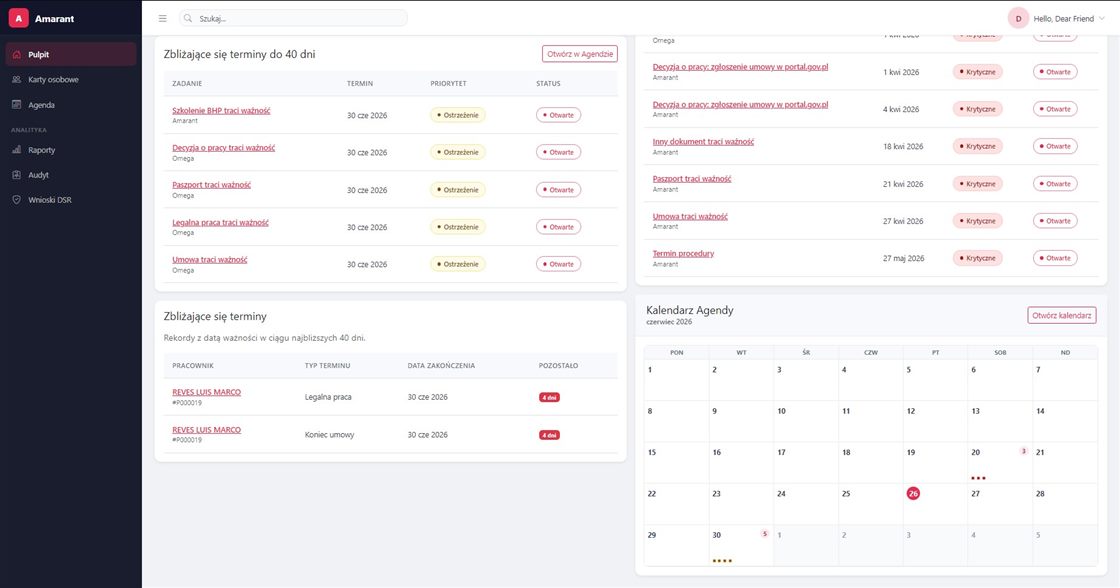
Karta pokazuje dokumenty, powiązania i daty ważności.
Zadania z statusem, terminem i kontekstem firmy.
Amarant organizes the legalization process while staying practical for teams working across devices, languages, and access roles.
The system is maintained in line with current legal requirements for legalizing foreign workers in Poland.
The system can be used from practically any Internet-connected device used in the company.
The system is available in three language versions: Polish, English, and Ukrainian.
The system can be personalized for each user, while administrators get tools for managing work and reporting.
The biggest risk is not the document itself. It appears when the deadline, company context, and next task are scattered across different tools.
Files sit in folders, deadlines live in spreadsheets, and decisions are buried in messages. It is hard to quickly check who owns the case and what needs to happen next.
The employee card, documents, residence and work deadlines, tasks, comments, and change history are connected in one place. The team sees case status and next actions without searching through many tools.
Documents, deadlines, procedures, Agenda tasks, and reports work in one system so the team can see every case stage without manually watching many tools.
Access to data, tasks, and reports is controlled by context and role. The system separates agency scope, company scope, module scope, and specific permissions.
"Before Amarant, we had an Excel file with deadlines and folders on a drive. Now documents, deadlines, tasks, and reports are in one place and visible to the whole team."
"The biggest difference is visible when handling many companies. We can work with different clients in one system while keeping documents, deadlines, and team responsibility organized."
"We support more than a dozen client companies, each with a slightly different workflow. Amarant gives us flexibility to manage cases separately for each company while controlling the process from one place."
The system is designed around RODO/GDPR principles and data security and encryption requirements. A flexible role model helps control access to information across the agency, client companies, and system modules.
Personal data, documents, and deadlines are managed in an organized way, with room for retention, data export, and data subject request handling.
The system records important case operations: status changes, comments, exports, logins, and user actions together with execution time.
Permissions can be split by role, company, and module, so users work only with the data they need for their task.
No hidden fees. You pay for active users and companies in the system.
No. Amarant is a system for managing the legalization process: employee cards, documents, residence and work deadlines, procedures, Agenda tasks, and reports. It can work alongside an HR and payroll system as a separate environment for legalization control.
Yes. After registration, you can create employee cards, add documents, control deadlines, and work with Agenda tasks right away. Roles and access restrictions can be refined gradually when the team needs more detailed control.
Yes. All data is stored on servers in the European Union. The system is compliant with RODO requirements, and a data processing agreement is a standard part of each contract.
Yes. You can gradually organize spreadsheet data and move it into employee cards. After that, documents, deadlines, tasks, and action history are managed in Amarant instead of scattered files.
Rules are configurable scenarios that the system checks automatically, for example when a work permit deadline is approaching. They can be defined by document type, company, or globally.
Do not postpone order for later. Add your first case today and see how quickly documents, deadlines, and tasks start forming one clear process.